Public Health Basics
The COVID pandemic proved the value of public health to save lives and improve health. Just a few public health services include vaccine clinics, restaurant safety, water quality, tracking disease outbreaks, and preventing health problems. Public health is among the best investments to improve the health of Connecticut residents, but it has been chronically underfunded. Connecticut spends about 1% of our state budget on public health for all 3.7 million residents, roughly equal to what we spend on medical care for about 10,000 prison inmates. California found that each dollar invested in public health returned $3.12 in savings to their states’ Medicaid programs. Unfortunately, public health’s savings go back into the medical care system; they are rarely reinvested in community health. However, public health professionals are facing serious challenges both in rising healthcare threats and eroding public trust.
Public Health Deeper Dive
What is public health?
“You and a friend are having a picnic by the side of a river. Suddenly you hear a shout from the direction of the water – a child is drowning. Without thinking, you both dive in, grab the child, and swim to shore. Before you can recover, you hear another child cry for help. You and your friend jump back in the river to rescue her as well. Then another struggling child drifts into sight . . . and another . . . and another. The two of you can barely keep up. Suddenly, you see your friend wading out of the water, seeming to leave you alone. ‘Where are you going?’ you demand. Your friend answers, ‘I’m going upstream to tackle the guy who’s throwing all these kids in the water.’”
A public health parable, from Upstream: The Quest to Solve Problems Before They Happen, by Dan Heath — https://heathbrothers.com/books/upstream/
In contrast to medicine, public health is concerned with preventing problems to improve the health of populations and communities. According to the CDC Foundation, public health is “the science of protecting and improving the health of people and their communities. This work is achieved by promoting healthy lifestyles, researching disease and injury prevention, and detecting, preventing and responding to infectious diseases. Overall, public health is concerned with protecting the health of entire populations. These populations can be as small as a local neighborhood, or as big as an entire country or region of the world.”
Services provided by public health include:
- Local vaccine clinics
- Infectious and communicable disease testing and tracking such as flu, HIV, tuberculosis, measles, and COVID
- Addressing issues such as substance abuse and overdose protection, mental health problems, suicide prevention, maternal health challenges, lead poisoning, mold and indoor air quality, beach water and shellfish sampling, rabies investigations, surveillance for bioterrorism agents, smoking, lack of physical exercise, disaster response, violence, poor diet, and food insecurity
- Lab services such as foodborne illness testing and virus typing
- Safety inspections of restaurants, hair salons, hospitals, and other facilities
- License and monitor healthcare providers for safety and qualifications
- Safety and health of septic systems and the water supply
Public health focuses on preventing health problems rather than the more costly treatment of patients when they are ill. Public health functions include vaccinations, tracking disease outbreaks, preventing injuries, and educating people about health risks such as tobacco and alcohol, among many others. Over the 20th Century, Americans’ life expectancy rose 62% and, contrary to public opinion, those gains were largely due to effective public health initiatives such as prevention and control of infectious diseases including:
- Vaccination
- Motor vehicle safety
- Safer workplaces
- Infectious disease control
- Reduce deaths from cardiovascular disease and stroke
- Safer and healthier food
- Maternal and infant health
- Family planning
- Fluoridation of drinking water
- Recognition of tobacco use as a health hazard
More recently however, progress has stalled. Americans’ rising life expectancy reversed course in 2014, even before COVID. US life expectancy rose again in 2023, but we still live 4.1 years less than comparison countries.
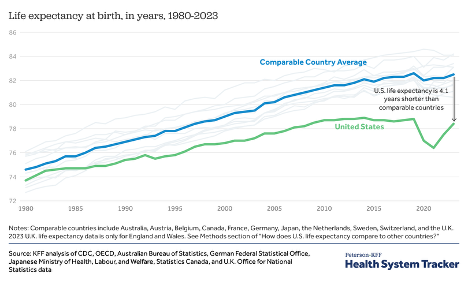
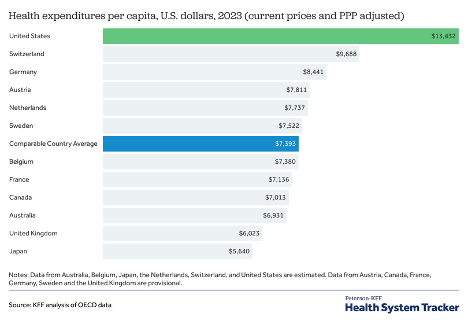
The US is now far behind other developed countries in health status. Americans live four years less, but we spend 177% more per person on healthcare than residents of other developed countries.
There is good evidence that state health policy makes an important difference in the health of state residents. Research has found a correlation between improved life expectancy and state policies on tobacco, labor, immigration, civil rights, and the environment.
What is the public health system?
Public health is largely sponsored by government, at all levels — federal, state, and local.
At the federal level, the Centers for Disease Control and Prevention (CDC) is the main sponsor of public health. Other federal agencies involved in public health functions include the Food and Drug Administration (FDA), Environmental Protection Agency (EPA), the Occupational Safety and Health Administration (OSHA), the Centers for Medicare and Medicaid Services (CMS), the Department of Agriculture (USDA), the Department of Transportation (DOT), the National Highway Traffic and Safety Administration (NHTSA), and the US Public Health Service, among others. It is important to note that, as of this writing in May 2025, the Trump administration is making large changes to the size, scope, structure, and mission of federal health agencies.
In Connecticut state government, the main public health agency is the Department of Public Health (DPH). Other agencies involved include the Department of Social Services (DSS) and the Department of Mental Health and Addiction Services (DMHAS), among others.
Connecticut has 61 local public health authorities. Large municipalities often have their own local health department. Smaller towns usually share public health responsibilities in a regional health district. Local health departments are responsible for monitoring the health status of their community, investigating local health problems and hazards, and educating residents about health issues, and connecting residents to healthcare when needed, among many other functions.
How is public health effective in improving the health of populations?
Experts estimate that only 20% of our health outcomes are connected to clinical care services. The rest is determined by risk factors connected to public health, including:
- 30% to Health Behaviors — tobacco use, diet and exercise, alcohol and drug use, and sexual activity
- 40% to Social and Economic Factors – education, employment, income, family and social support, and community safety
- 10% to Physical Environment – air and water quality, and housing and transit
While Connecticut residents tend to be more healthy than other Americans, we are still facing serious health challenges like the rest of the country. According to the latest CDC survey:
- Depression affects 19% of Connecticut adults
- Diabetes affects 10% of Connecticut adults
- 20% of Connecticut adults eat less than one serving of vegetables per day, and 35% get less than one serving of fruit
- 29% of Connecticut adults are obese and another 37% are overweight
- Only 31% of Connecticut adults get recommended levels of physical activity
- 8% of Connecticut adults are current smokers
Investing in public health is smart, saving more lives for less money than other health interventions. California found that for every dollar devoted to public health spending, its Medicaid programs saved $3.12. Unfortunately, those savings go back to the medical system, and not reinvested in communities and public health initiatives that could save more lives.
There is a great deal of research identifying public health interventions that are proven to improve health and lower total healthcare costs. Among the most effective are tobacco control, food safety, reducing infections in healthcare settings, motor vehicle injuries, teen pregnancy, and improving nutrition, physical activity, and lowering obesity rates. Searchable databases have made it easy to prioritize initiatives and identify best practices. There is help for state policymakers in using that research to implement proven interventions.
Are we spending enough on public health?
No.
Historically the US and most states, including Connecticut, have not funded public health at levels sufficient to maximize the public’s health. In 2018, of every dollar spent on medical care, the U.S. spent only 2.5 cents on public health. From 2008 to 2018, U.S. spending on health care grew 4.3% while public health funding was flat.
Like the rest of the country, our state devoted a lot of money into public health to combat COVID, because we needed to. But we tend to forget about investing when times are good, paying the price next time for our usual neglect, panic, repeat cycle.
The neglect of public health funding has coincided with declines in life expectancy, rising health disparities, and the resurgence of diseases such as measles that we’d beaten in the past. Experts have called for annual investments of $4.5 billion at the federal and state levels to realize public health’s potential to improve health.
Connecticut spends only 1% of our state’s health budget on public health to improve the health of all 3.7 million state residents. We spend almost twice as much providing medical services for roughly 10,000 prison inmates.

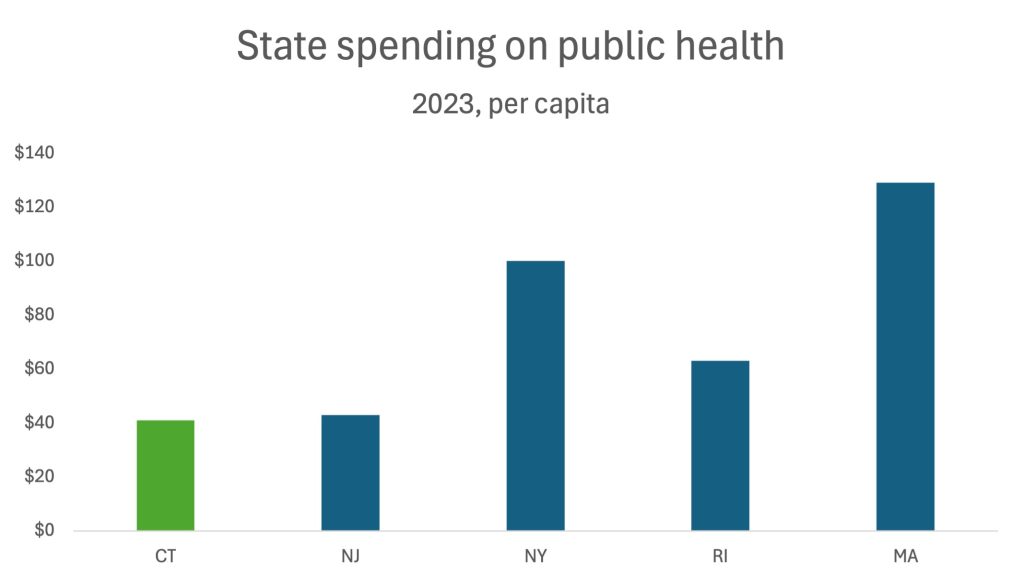
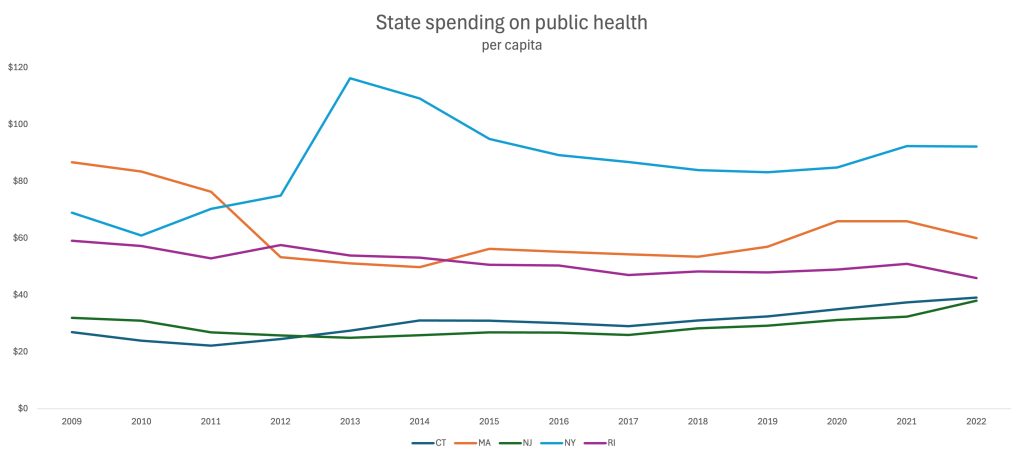
Connecticut lags behind comparison states in per person state spending on public health, both in level of spending and over time. In 2023, we ranked 26th among states, below Rhode Island, Massachusetts, New York, and New Jersey.
Under federal law, nonprofit hospitals are required to report expenditures, including revenue losses, they provide to benefit the communities they serve. This is a condition of their nonprofit status and tax exemptions. In 2023, Connecticut hospitals reported $2 billion in total community benefits. However, 61% of that total represents the amount they believe they are underpaid for services by Medicaid, educating their health professionals accounted for 15% of the total, and 14% represented financial assistance or charity care covering unpaid patient bills. None of these represent traditional public health functions.
Each nonprofit hospital is also required to conduct a Community Health Needs Assessment (CHNA) every three years to maintain their nonprofit tax breaks. They are not required to fund the needs identified in their CHNA. The CHNA assess the health needs of the communities they serve, solicit input from community representatives, including public health sources, and make the report public. Connecticut hospitals’ CHNAs are listed here.
Trends and Challenges
Connecticut’s public health is facing some very serious challenges. In addition to the rising rates of preventable illnesses and inadequate resources, there are new challenges threatening progress. Social determinants of health, including economic and safety pressures, are a growing a threat to the public’s health.
As of this writing in May 2025, the Trump administration has implemented deep cuts in federal public health agencies and grants. About 20% of Health and Human Services agency staff have been laid off. The state has lost millions in public health grants. Local Connecticut health directors are making hard decisions including cutting vaccine clinics, infectious disease tracking, health education, and laying off staff. Over two thirds of Americans oppose the Trump administration’s cuts to health agencies.
Public health practitioners are facing more challenges getting their messages across. Trust in public health agencies, both federal and state, has eroded over time. COVID created challenges to trust in public health leaders, and that mistrust has persisted. Only about half of Americans trust national or local leaders or agencies. There is a significant political divide between Republicans and Democrats on who to trust. While most parents (82%) still keep their children up to date with vaccines, that number is down, especially among Republicans. It’s critical for public health leaders to assess and learn from COVID missteps,
In addition, public health authorities face structural and political problems including:
- Containing and preventing the spread of new, and old, infectious diseases
- Maternal and child health issues
- Supporting and expanding the public health workforce
- Substance abuse and overdose prevention
- Updating critical public health data to identify and protect threats while protecting privacy
Updated May 20, 2025