Quality Basics
Despite our high costs, the quality of healthcare in Connecticut is average, and it’s not improving. There is room to improve, especially in avoidable ED and hospital care, hospital readmissions, and community health centers. The significant variation between providers offers important learning opportunities to improve care.
Connecticut has troubling disparities in healthcare outcomes by race and ethnicity.
Quality is complicated to measure, but evidence-based metrics are available. Good quality measurement is critical to lowering costs, avoiding unnecessary care, improving health status, and overall population health. Quality measurement is constantly improving to focus on improving health outcomes, promoting health equity, and to support patients in healing.
There is little connection between high prices and better quality in healthcare.
Quality Deeper Dive
How is healthcare quality measured?
Measuring quality is complex. Unlike healthcare spending, which is measured in dollars, quality is measured over thousands of different metrics. However, there are evidence-based, proven metrics and methods to measure quality and improve it. The National Quality Forum (NQF), a nonprofit nonpartisan organization created in 1999 to promote healthcare quality measurement and reporting. NQF sets standards for healthcare quality metrics and has endorsed over 700 different performance measures.
In healthcare, we aren’t getting what we pay for; prices and quality do not correlate well. An analysis of Connecticut commercial hospital payment rates found there was no correlation between higher prices and higher quality, based on CMS quality star ratings. A research synthesis of published literature found that roughly a third of measures and prices were aligned, another third had no relationship, and in the last third prices were higher for worse quality care. Another study found no relationship between high hospital prices and lower mortality.
There is a growing consensus that quality measurement needs to shift away from process metrics, based on provider actions which are easy to measure and often self-reported. Outcome-based measures that reflect improvement in health status are key to improve people’s health. It is more important to measure how many patients’ blood pressure was controlled rather than the number of blood pressure checks.
The potential for quality measurement to improve health equity is adding focus to the field. New measures specifically designed to reduce disparities and the data capacity to collect them are developing. Targeted populations include race/ethnicity, gender and sexual orientation, disability, and urban/rural, among others. Measuring the impact of interventions designed to reduce disparities will be key to building a health system that works for everyone.
There is also movement toward quality measures and setting goals that matter to patients. This is especially critical for underserved populations, where trust in healthcare is low. Patients must be engaged in their healing. Patient-centered goals such as “being able to leave the house on my own” are far more likely to be achieved than a set of clinical metrics. Person-driven care is more likely to reduce costly and unnecessary care that doesn’t improve health.
Patient satisfaction, or patient experience of care, surveys allow evaluators to see across health outcomes and populations to find challenges and successes they didn’t know to look for. The gold-standard Consumer Assessment of Healthcare Providers and Systems (CAHPS) survey was developed decades ago by independent researchers at the federal Agency for Healthcare Research and Quality. Based on over 400 studies, it has been updated for multiple populations to ensure its value in improving healthcare quality. It is used by Medicare, most health care systems, insurers, and 47 state Medicaid programs.
How is Connecticut’s healthcare quality?
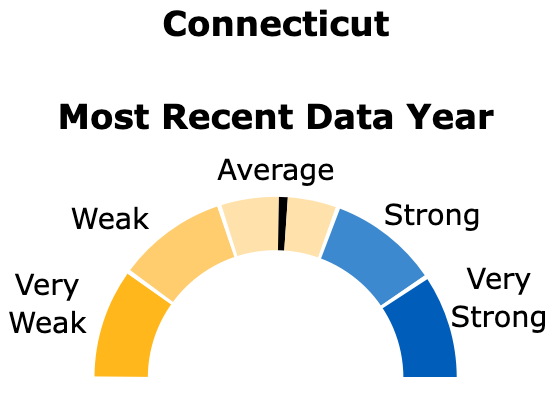
The latest federal 2023 National Healthcare Quality and Disparities Report from the Agency for Healthcare Research and Quality (AHRQ) rates healthcare in Connecticut as average. Across 189 measures of quality, Connecticut was above the US average on 44, below average on 42, and average for the remaining 103. And progress is slow. Compared with baseline years for each measure, we improved on just 85 measures and performed worse on 57.
According to AHRQ, Connecticut does well in Medicaid and Medicare Advantage patient satisfaction. We are also above average in preventive care – vaccines and screenings – as well as cancer deaths and the health of people living with HIV. However, we are below average in multiple metrics in home health, hospice, and nursing home care. We also have higher than average rates of deaths per hospital admissions for a variety of conditions.
According to the Commonwealth Fund 2025 State Scorecard, while Connecticut’s health system ranks 11th best in the nation overall, we are also 48th worst among states in avoidable hospital use and cost. That was our worst performance area by far. Our best areas were children getting needed mental healthcare, adults with a dental visit, and childhood vaccines. Our worst performance metrics included hospital readmissions for skilled nursing facility patients, adults with diabetes not getting hemoglobin A1c tests, and hospital patient experience ratings. For seniors, we are 47th in the nation in avoidable ED visits, 31st in hospital admissions for preventable conditions, and 42nd for hospital readmissions. This is despite spending more per Medicare beneficiary than all but seven states.
According to the 2024 quality report from Connecticut’s Office of Health Strategy, our state has significant disparities in healthcare outcomes by race and ethnicity. Connecticut Black and Hispanic children and teens in our state are 5.5 and 4.5 times more likely to visit an ER for asthma, respectively, than white children and teens. Blacks and Hispanics with diabetes in our state are 2.2 and 1.5 times more likely to need an amputation than white state residents with diabetes. Black state residents are 29% more likely to die of heart disease than white state residents.
In some good news, the state Office of Health Strategy found that Emergency Department (ED) visits in Connecticut dropped from 1.6 million in 2016 to around 1.3 million in 2021. Overall Medicaid and Medicare beneficiaries, the uninsured, Black Non-Hispanics, and adults between ages 18 and 44 years old, are more likely to seek care in an ED.
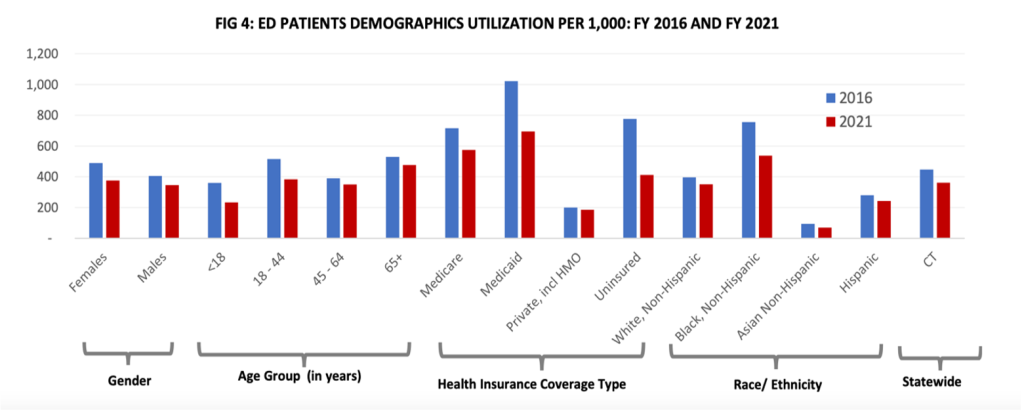
A substantial number of ED visits may have been avoided by timely, appropriate outpatient care from a primary care provider, urgent care center or clinic. Patients’ misperceptions of the severity of their illness or were advised by their primary care provider to go to the ED account for a large portion of preventable visits. Unnecessary ED visits stress the health care system with high costs and by shifting resources from higher acuity patients. Improving patient access to preventive care, education on when to seek emergency care, and care coordination for patients with complex, chronic conditions could ease the stress on the health system.
Unfortunately, Connecticut’s community health centers (also called Federally Qualified Health Centers, FQHCs) are not doing as well as their counterparts in providing quality care. From 2016 to 2018, Medicaid FQHC patients were more likely to visit an ER than Medicaid patients cared for by other practices. Child Medicaid members with asthma cared for at an FQHC were more likely to visit the ER than other children covered by Medicaid. FQHC Medicaid patients also experience more potentially avoidable hospital admissions, readmissions within 30 days, fewer well-child visits, and lower patient satisfaction scores than other providers.
The 2024 March of Dimes Report Card gives Connecticut a C+ grade on how well we care for new moms and babies. We have a preterm birth rate at 9.3% of live births in 2023, that hasn’t moved much since 2013. Babies born too early can have serious long-term health problems including cerebral palsy, impaired learning, behavioral and psychological problems, hearing and vision problems. Preterm birth rate for Black Connecticut babies is 1.4 times higher than for white babies. That gap hasn’t changed over time.
In good news, mortality for pregnant women in Connecticut is lower than the US average and they are more likely to get adequate prenatal care than most American mothers. However, Connecticut’s low-risk, first time moms are more likely to have a Caesarian birth than the US average.
How is hospital care quality in Connecticut?
Overall, the quality of care at Connecticut hospitals is average, and not improving.
Care Compare on Medicare.gov includes hospitals’ performance on dozens of quality metrics. Overall, Connecticut hospitals perform at the national average – 3.1 stars for overall performance and 3.1 stars for patient satisfaction. Across both those measures, only Sharon Hospital achieves a 5-star rating (on overall performance, and 4 stars on patient satisfaction).

Connecticut’s Department of Public Health reported 454 adverse events at hospitals in 2023. According to the US Agency for Healthcare Research and Quality, adverse events are “unintended physical injury resulting from or contributed to by medical care that requires additional monitoring, treatment or hospitalization, or that results in death.”
Between 2013 and 2023, Connecticut hospitals averaged 408 adverse events annually. There has been little change in the adverse event rate since 2013. Connecticut acute care hospitals averaged 12.1 events/100,000 patient days in 2023 — St. Francis had the highest rate at 23.5 and Rockville General was the lowest with no adverse events.

Some of the most common adverse events reported to DPH include:
| CT hospital adverse events reported to DPH, 2023 | |
| Surgery performed on the wrong site | 12 |
| Wrong surgical procedure performed on a patient | 4 |
| Retention of a foreign object in a patient after surgery or other procedure | 18 |
| Patient suicide, attempted suicide, or self-harm that results in serious injury, while being cared for in a healthcare setting | 18 |
| Patient death or serious injury associated with a medication error (e.g., errors involving the wrong drug, wrong dose, wrong patient, wrong time, wrong rate, wrong preparation or wrong route of administration) | 10 |
| Patient death or serious injury associated with a fall while being cared for in a healthcare setting | 101 |
| Any Stage 3, Stage 4, or unstageable pressure ulcer acquired after admission/ presentation to a healthcare setting | 221 |
| Any incident in which systems designated for oxygen or other gas to be delivered to a patient contains no gas, the wrong gas, or are contaminated by toxic substances | 33 |
| Sexual abuse/assault on a patient or staff member within or on the grounds of a healthcare setting | 11 |
| Death or serious injury of a patient or staff member resulting from a physical assault (i.e. Battery) that occurs within or on the grounds of a healthcare setting | 8 |
Connecticut hospitals, shown below, vary in the percent of patients who have an unplanned readmission to the hospital within 30 days after discharge, according to an analysis by Mathematica, using data on health systems from the federal Agency for Healthcare Research and Quality.
The Excess Readmission Ratio (ERR) is calculated as the ratio of each hospital’s 30-day unplanned readmissions divided by the expected number of readmissions among similar hospitals. Hospitals with above average ERRs (over 1.0) are penalized by Medicare.
The data is broken down by condition — Acute Myocardial Infarction (AMI), Coronary Artery Bypass Graft (CABG) Surgery, Chronic Obstructive Pulmonary Disease (COPD), Heart Failure (HF), Elective Primary Total Hip Arthroplasty and/or Total Knee Arthroplasty (THA/TKA), and Pneumonia (PN). The median ERR across all Connecticut hospitals is above the predicted level (1.0) for every condition.

Source: CT hospitals filter, Health Systems Dashboard, Mathematica, Accessed 9/11/2024, (shared with permission)
How is the quality of care for Connecticut Medicaid patients?
HUSKY is a bright spot for Connecticut, leading the nation in quality and access to care for Medicaid members.
According to Medicaid.gov in 2022:
- 73.3% of Connecticut children and adolescents had a checkup, compared to 54.2% national average
- Child health — Connecticut scored better than the national average in 16 of 22 priority adult quality measures, Connecticut was in the top quarter of states for 13 of those measures
- Adult health — Connecticut scored better than the national average in 20 of 28 priority adult quality measures, Connecticut was in the top quarter of states for 17 of those measures
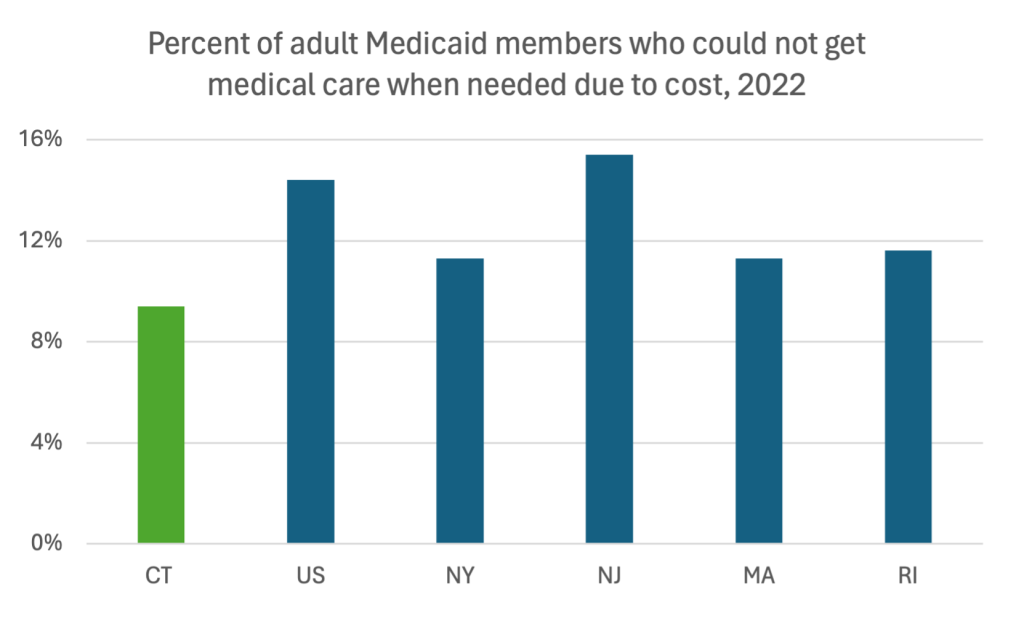
According to the State Health Access Data Assistance Center (SHADAC) at the University of Minnesota, adult Connecticut Medicaid members are less likely to report an inability to access care due to cost than the US Medicaid average or members in comparable states.
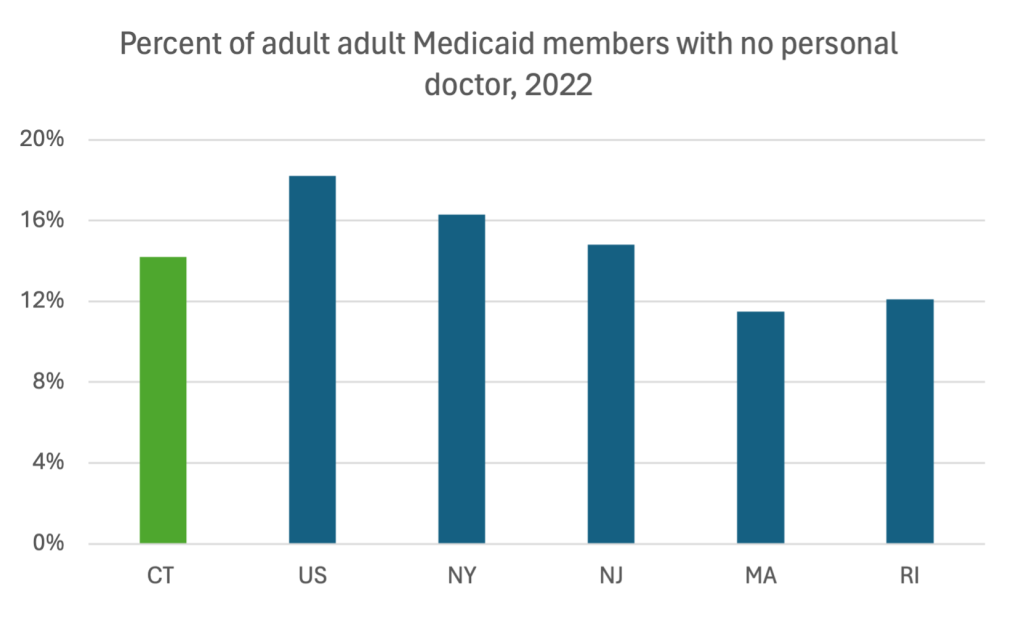
Also according to SHADAC, Connecticut adult Medicaid members are less likely than most US Medicaid members to report not having a personal doctor. We are similar to comparable states on this metric.
A study published in January 2024 found cancer outcomes improved for Connecticut Medicaid members starting in 2012 when we removed MCOs from our program. Rates of early-stage cancer diagnosis were 4% higher and cancer survival was 8% higher among Connecticut Medicaid members than in New Jersey, a demographically comparable state that still has MCOs.
Trends
- There is potential to improve healthcare quality in Connecticut, but we need to prioritize it and pay for improvement.
- We must move from easy process metrics to meaningful health outcome measures that impact patients’ health
Updated October 2, 2025