Prescription Drug Basics
Soaring prices for drugs are driving healthcare costs, making care unaffordable and forcing sacrifices for families and taxpayers. Pharmacy spending for Connecticut residents grew 9.9% from 2023 to 2024. Drug spending is driven by higher drug prices, not increased use of drugs.
Drug companies are very profitable, more than other industries. Drug companies increase their profits with advertising and direct payments to physicians. Drug companies spend more on marketing than they do developing new drugs. Pharmacy Benefit Managers (PBMs), an industry of middlemen that are charged with negotiating lower prices, can also increase drug prices to drive their profits.
US per person prescription drug spending is two and a half times the prices in comparable countries. Unlike other countries, US insurers negotiate drug prices with companies. Drug companies can demand high prices through patent protections and other market strategies that create monopolies. The FDA assesses new drugs for safety and effectiveness but does not consider price in their reviews.
There is substantial evidence that drug prices are far higher than needed to recover companies’ research costs. In addition, drug development is heavily subsidized by the federal government in multiple ways. There are concerns that the profit motive is keeping drug companies from developing truly innovative drugs that could improve health for millions in favor of more lucrative “safe bets.” Drug companies make substantial donations to influential federal and state lawmakers. They spend even more donating to non-profit patient advocacy groups that should be representing the interests of patients who pay the high prices.
Medicare is now negotiating prices for some drugs with pharmaceutical companies and penalizing companies that raise the price of drugs more than the rate of inflation — saving patients and the Medicare program substantial sums. The number of negotiated drugs grows each year.
In 2025, Connecticut passed legislation capping generic drug price increases to the rate of inflation. However, drug distribution companies have filed a lawsuit objecting to the law.
Under the second Trump administration, there are concerns about reversal of expert committee guidance on drug regulation and advice to clinicians. Non-government independent experts have formed alternative structures that rely on evidence to advise clinicians and patients.
Prescription Drug Deeper Dive
Prescription drugs offer incredible potential to heal and save lives. New gene therapies have the potential to cure diseases that have few, very expensive treatment options. While prescription drug costs have risen, some can help prevent more costly care such as inpatient hospital admissions or emergency room visits. But too many costly new drugs have little evidence that they are effective and are not worth their prices. Prescription drug prices in the US average 2.78 times the prices paid for the same drugs in 32 other countries.
Drug costs are rising, driving total healthcare spending
Prescription drug prices are driving up healthcare costs that are squeezing family, employer, and government budgets — displacing other healthcare spending and other important priorities. The causes of high drug prices are complex.
Due to high costs, 23% of Connecticut residents cut pills in half, skipped medication doses, or didn’t fill a prescription in 2025. Nearly half of Connecticut residents are worried about affording needed prescriptions. Lower income households, people with disabilities, and unemployed and part-time workers are at highest risk of missing needed medications due to cost.
According to the 2026 state healthcare cost growth report, Connecticut residents spent on average $1,999 per person on prescription medications in 2024, up 9.9% from 2023. That’s 17% of total per capita healthcare spending. Ten years earlier, Connecticut spent just 15% of our total healthcare costs on prescriptions. Prescription drug costs rose faster in 2024 than all but one other category (long term care).
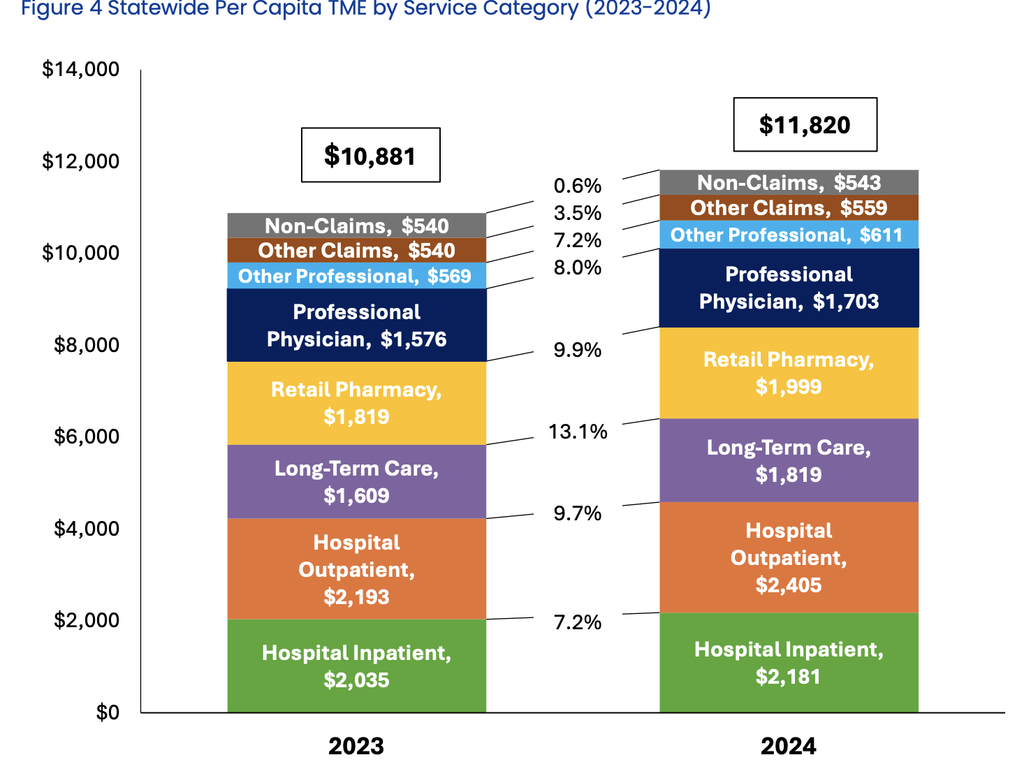
Total prescription drug spending for all Americans grew by 7.9% from 2023 to 2024. It is expected to grow faster than any other category through 2034.
Drug spending is driven by higher drug prices, not increasing use of drugs. In 2025, US prescription drug prices increased 10.6% while total prescriptions used rose only 1.5%. Expensive new drugs, such as GLP-1s for diabetes and obesity, are driving up costs.
In good news for consumers, patents will soon expire for some very expensive drugs, lowering US drug spending costs by $230 billion. The record-breaking drugs Ozempic, Keytruda, and Opdivo are on the list. The last patent cliff significantly lowered prices for the affected drugs.
Drug companies are very profitable. From 2000 to 2018, thirty-five large drug companies’ profits averaged 13.8% of revenue. This is far higher than other industries where profits for 357 large, non-pharma companies averaged 7.7%. An analysis found that drug companies could lose $1 trillion in sales, without reducing research and development spending, and still be the most profitable industry. A new analysis finds that from 2017 to 2024, drug manufacturers’ profits (23.2%) dwarfed other industries in the drug supply chain, including health insurers (3.2%).
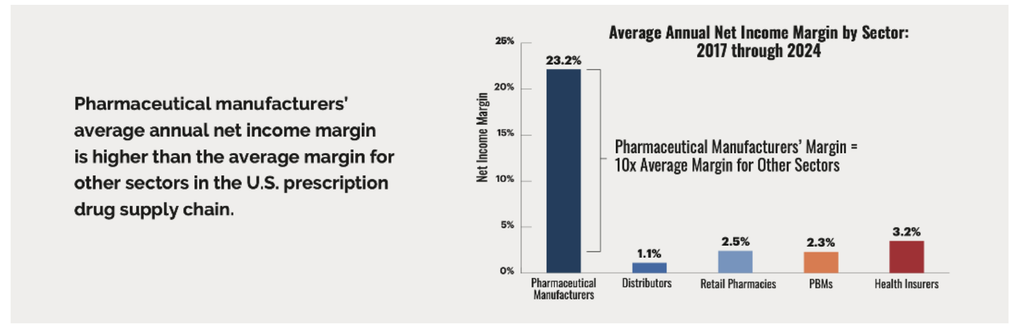
Drug companies argue that they need high profit margins to fund new research, to cover the cost of drugs that fail in clinical trials, and to comply with regulation by the federal Food and Drug Administration (FDA).
Drug companies increase their profits with advertising and direct payments to physicians. Every country but the US and New Zealand prohibit direct-to-consumer advertising by drug companies. There is good evidence that these payments influence the medications that physicians prescribe. In 1997 when the US removed a similar restriction, drug spending increased substantially. Drug companies spent over $10 billion on advertising drugs to consumers in 2024, paying for almost 25% of evening TV ads. In 2025, a bill was proposed in the US Senate to prohibit direct-to-consumer advertising, however the bill did not pass.
In addition, drug companies spend about $2 billion in payments to about half of all US physicians. A study found that every dollar paid to physicians was associated with $23 more in prescriptions of the companies’ drugs. The payments include free meals, luxury travel, and consulting fees. In 2025, the average payment from medical companies to Connecticut physicians was $3,633.38, the 18th highest among states.
Intensive and sometimes obscure marketing also raises drug prices. Drug companies spend about $8 billion annually on direct-to-consumer advertising for costly brand name drugs that have lower-cost alternatives. Drug companies also offer providers free samples of high-cost drugs to their patients. While this eases patient costs initially, when out-of-pocket costs begin, patients are unlikely to switch to a lower cost drug raising costs for both patients and insurers.
Drug prices don’t always match their value
Too many new drugs are priced well beyond the value of their benefits to our health. For example, researchers estimate that Medicare paid $2.9 billion between 2009 and 2015 for a dry-eye drug with little evidence that it works.
The controversy over Aduhelm, Biogen’s Alzheimer’s treatment, demonstrates the problem. Alzheimer’s patients are desperate for an effective treatment. But with limited effectiveness and serious safety risks, the drug was severely overpriced. Many insurers and Medicare decided not to cover it, or only in very limited circumstances, and many hospitals refused to treat patients with the drug.
Another example, Trodelvy, an oncology drug made by Gilead, costs $16,000 for a 21-day treatment cycle. The company said the drug reduced the risk of death by 49%. However, the medication only extended median survival from 4.9 months to 11.8 months. An analysis of the 90 cancer drugs approved by the FDA in the last century found that the average survival gain is just 73 days.
In the US, the nonprofit Institute for Clinical and Economic Review is an influential source providing policymakers and other payers with expert, independent research on effectiveness and fair prices for drugs and other treatments. ICER’s assessments frequently suggest significantly lower prices for treatments that do not provide much added benefit, while supporting higher prices for treatments that do, maintaining strong financial incentives for innovative new treatments.
ICER’s research is used by clinicians, federal agencies, insurers, and state policymakers to set reasonable drug prices. ICER’s reports include evidence-based calculations of prices for new drugs that accurately reflect expected improvement in long-term patient outcomes, while also highlighting price levels that might be unaffordable for the entire health care system. ICER relies on scientific studies and patient input in developing their reports. ICER’s first analysis of fair access policies led six national insurers to change restrictive policies making treatments more available to patients.
Drugs cost less in other countries
In the US, a month’s supply of a dry-eye drug costs $800 and requires a prescription from a provider. In Europe, the same drug is sold over the counter for $20. This is not an isolated example.
The US is unique among developed countries because we negotiate drug prices in the private market and do not base prices on the effectiveness of medications in improving health. Other developed countries evaluate medications’ relative effectiveness in improving health compared to lower-priced current treatments and set prices accordingly. However, US drug prices in commercial insurance plans are set by the market. Companies can use monopoly power and patent protections to keep new drug prices high for years, even decades. Covering extremely expensive drugs with limited value is driving up US healthcare costs, keeping the effective medications from American patients who need them, and sacrifices resources for other valuable healthcare services.
A 2021 analysis found that prescription drug prices in the US average 2.56 times the prices paid for the same drugs in 32 other developed countries. Among the 32 countries studied, the US accounted for 58% of spending, but only 24% of total drugs sold.
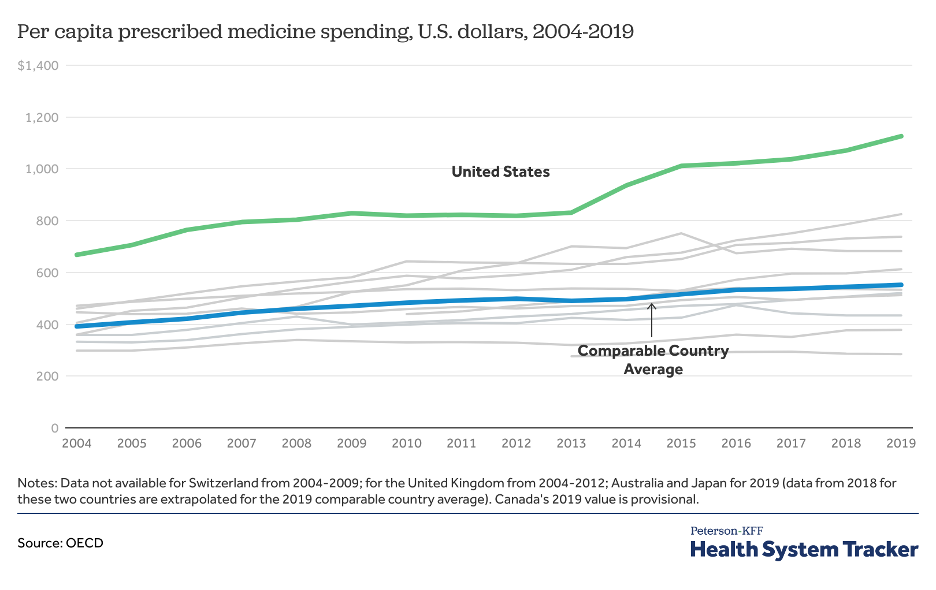
Our higher prices do not buy us better access to innovative drugs. While Americans pay twice as much as Canadians for drugs, the availability of important therapeutic medications in the US is similar to Canada.
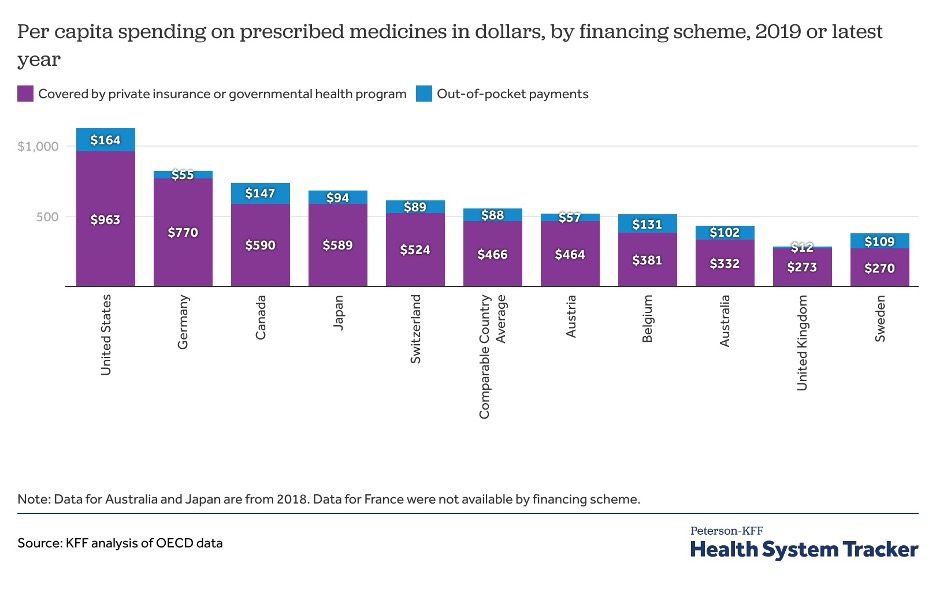
Americans pay for these higher prices in both our direct out-of-pocket costs, such as copays and deductibles, hidden in our high insurance premiums, and in higher taxes for government coverage programs such as Medicare and Medicaid. US drug out-of-pocket costs are 86% higher than other developed countries and insurance/government health program costs are 107% higher.
What is government’s role in regulating drugs in the US?
The federal Food and Drug Administration (FDA) assesses the safety and effectiveness of new drugs before they can be sold in the US. A team of FDA physicians, scientists, and statisticians evaluate the evidence from the manufacturer about the new drug, weighing risks and benefits. The FDA cannot consider the costs of drugs in their process. Since 1972 the FDA has consulted with Advisory Committees of outside, independent experts in public meetings, including consumer and patient representatives, in making regulatory decisions. In the meetings, experts and consumer representatives voice concerns by questioning and challenging both agency staff and drug company representatives to ensure that new drugs are safe and effective. Anyone can apply to join an Advisory Committee.
However, under the Trump administration, FDA Advisory Committees have moved away from expert and independent membership to less qualified members with financial conflicts of interest. The agency is also consulting Advisory Committees less often and holding fewer meetings. Academics, provider associations, and clinical experts have created alternative evidence-based committees to advise clinicians on evidence-based care standards.
FDA approved drugs benefit financially from patent and market exclusivity protections that prohibit other companies from copying and selling the new drug for an average of twelve years. After these protections end, other companies can compete with the original company by copying and selling the drugs as generics or biosimilar medications at lower prices. Patents and market exclusivity were designed to promote innovation by allowing drug companies to charge higher prices for a reasonable time to recover their costs of developing drugs.
However, concerns have been raised that drug companies are using FDA and patent processes to extend their monopolies to keep drug prices high, harming patient access to medications, and raising total healthcare costs by billions of dollars. Strategies include
- patent evergreening — patenting clinically irrelevant features of the drug to extend the patent protection
- product hopping – switching patients to a similar, new drug with a longer patent or exclusivity period
- patent thickets – overlapping patents on a drug to deter competition with litigation costs
- pay-for-delay – paying a generic or biosimilar company to delay producing a competitive product at a lower cost
In 2022, Congress passed historic legislation allowing the Medicare program to negotiate drug prices with pharmaceutical companies. Negotiation only applies to some drugs and only those that are seven to ten years since their FDA approval. Every year more drugs are chosen for negotiation, gradually adding to the list of lower priced drugs. The drugs selected are based on Medicare’s highest spending medications and have no generic version.
In August 2023, the first ten drugs were chosen, and the prices went into effect in January 2026. They include treatments for diabetes, cancer, blood clots, heart failure, and rheumatoid arthritis. The new prices are working, saving both the Medicare program and beneficiaries billions of dollars and increasing access to medications. Savings are expected to increase significantly in 2026 and 2027.
Pharma argues that price negotiation harms innovation, but experts predict about a 1% drop in new drugs. Pharma also argues that negotiation is another term for price controls and that most of the benefits will go to government rather than patients. However, experts point out that it is a negotiation and that taxpayers will benefit if prices are lower. Drug companies have filed numerous lawsuits to stop Medicare drug price negotiation with no success.
Also in 2022, Congress passed legislation imposing penalties on drug price increases that are more than the rate of inflation. In 2023, the administration imposed significant penalties on makers of 48 drugs saving Medicare members between $1 and $2,786 per average dose.
As of January 1, 2026, a new Connecticut law limits increases in generic drug prices to the rate of inflation under penalty of fines. However, drug distribution companies have filed a lawsuit against the state claiming the law violates due process rights.
In 2020, Connecticut passed a limit on patient out-of-pocket costs to $25 for a 30-day supply of insulin or other diabetes medications and a $100 cap for 30-days’ worth of devices and supplies. The limit only applies to state-regulated insurance plans.
Costs to develop new drugs
Insulin was discovered and patented a hundred years ago by Frederick Banting and colleagues at the University of Toronto. The discovery meant that diabetes was no longer a death sentence. They sold the patent for $1 because they wanted insulin to be available to anyone who needs it. Unfortunately, insulin is now so costly that one in four patients has to ration doses, endangering their lives. Diabetes was Connecticut’s seventh-leading cause of death in 2017. Even though it was discovered a century ago and all research and development costs have been recouped, the three companies that control the market are using patent abuses to keep prices high.
It is a long process to develop new drugs. For every 5,000 promising new drugs, on average just one is eventually approved by the FDA to treat Americans. It can take up to 15 years to move one drug through the full development process. It is estimated that, including failed drugs, companies spend $1 to $2 billion to develop each new drug. Pharma notes this as one of the reasons that drug prices are so high.
However, most researchers estimate that drug companies more than recover those development costs when drugs go to market. In 2015, companies with the twenty top-selling drugs generated revenues almost twice (176%) their development costs from just the US market.
The federal government also provides substantial support and subsidies to drug companies for research and development costs. Federal payments of $22 billion to drug companies to develop COVID-19 vaccines are only one example. The federal government is the largest funder of basic biomedical research, which forms the basis of much drug development. Funding from the National Institutes of Health (NIH) alone was $41 billion in 2020. Development of every drug approved by the FDA from 2010 and 2016 was based on NIH-funded research. On top of direct subsidies, the federal government grants substantial tax breaks to drug companies on their research and development spending. The federal government also grants patents and exclusive marketing rights to newly approved drugs, allowing them to charge prices that more than recoup those costs. Medicare, Medicaid, and other government coverage programs support drug development by driving demand for drugs. In 2019, the federal government paid for 40% of total US prescription drug spending.
It’s been argued that pressure to make big profits and the expense of research and development combined with high failure rates of potential drugs inhibit innovation. The imperative to make very high profits keeps drug companies from researching new “wonder drugs” that could have made a meaningful difference for the health of millions, such as new antibiotics and vaccines. The concern is that the pressure for profits drives drug companies to prioritize “safe bets” with their research budgets, to develop drugs that are more likely to be successful and profitable.
The role of Pharmacy Benefit Managers, PBMs
Drug companies blame Pharmacy Benefit Managers (PBMs) for increasing drug prices. PBMs manage prescription drug costs for insurers, Medicare Part D plans, employers, and others. Combining their market power should PBMs to negotiate better prices from drug companies for all. PBMs keep costs down by developing formularies, lists of covered drugs, securing rebates from drug companies, and by contracting directly with pharmacies.
PBMs have lowered prescription drug costs for payers, but they remain controversial. Because PBMs are often paid based on the rebates they can secure from drug companies, they have an incentive to allow companies to raise list prices but also increase rebates. Rebate savings aren’t shared with consumers, so patients pay more. PBMs also profit through “spread pricing’, charging insurers and government programs higher prices for drugs than what they pay to drug companies, keeping the difference.
Consolidation and conflicts of interest among PBMs have raised more concerns about pricing. Three PBMs control 80% of US prescriptions allowing them to demand higher prices for their services. All three are owned by insurers, allowing them to steer patients to specific pharmacies with higher reimbursements further increasing profits. The Federal Trade Commission and members of Congress have raised concerns.
Why haven’t policymakers lowered prices for all Americans?
In 2022, Congress passed historic legislation directing the Medicare program to negotiate drug prices with pharmaceutical companies. The new prices are working, saving both Medicare and beneficiaries billions of dollars and increased access to medications. Savings are expected to increase significantly in 2026 and 2027.
To lower the costs of drugs for all Americans, President Trump has developed Trump Rx, a program of negotiated discounts on select drugs. However, the prices only work for Americans directly purchasing their drugs such as the uninsured and people with high deductibles. While some people may save money, most don’t, and many of the deals haven’t been enforced and may lapse.
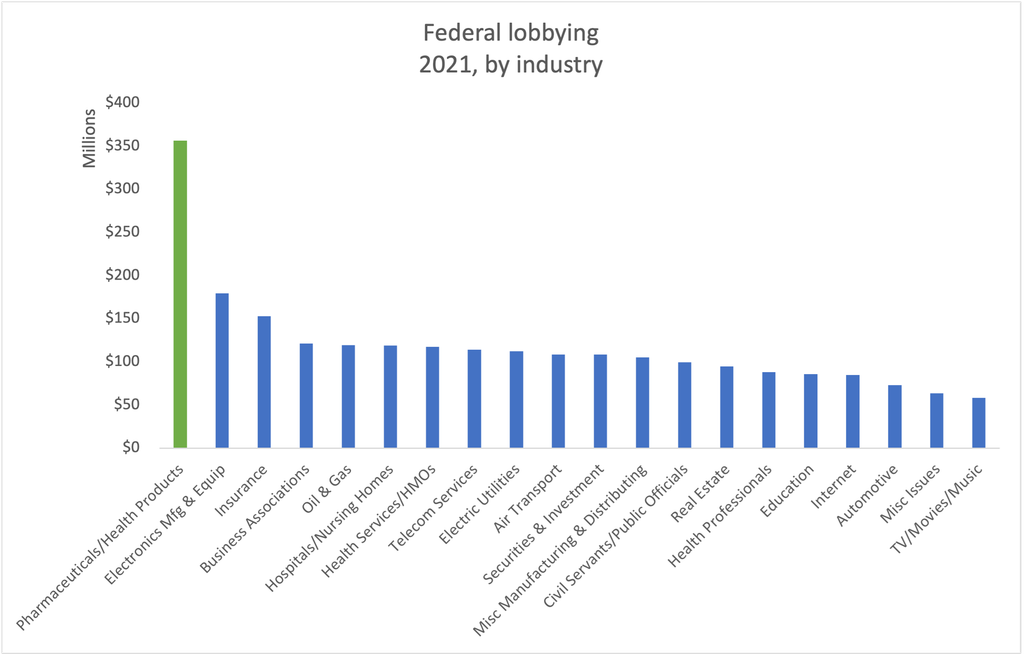
Despite years of complaints from businesses and voters, Congress and states have made little progress in lowering prescription drug prices beyond Medicare. There are several reasons including direct lobbying by Pharma, donations to Congressional and state political candidate campaigns, and payments to nonprofit patient advocacy organizations.
Lobbying is another barrier to drug price controls. Drug companies spend more on lobbying Congress than any other industry. In 2025, pharmaceutical and health services companies spent over $457 million lobbying federal policymakers.
Drug companies support Congressional and state candidates that are friendly to the industry. In the first half of 2021, drug companies donated $1.6 million to Congressional candidates, targeting members of committees that oversee the pharmaceutical industry. In 2020, drug companies supported 2,400 state legislative campaigns.
In addition, drug companies make payments to non-profit patient groups. In 2015, pharmaceutical companies paid non-profit patient advocacy groups $116 million; that is more than they spent lobbying Congress that year. A 2017 study found that 83% of patient advocacy organizations receive payments from drug companies. At least 39% received over $1 million. Over a third (36%) appointed an industry representative to their Board of Directors, with influence on nonprofits’ advocacy agendas. Companies directly finance patients to lobby Congress for their cause through some patient groups. Serious concerns have been raised that groups are less likely to advocate for lower drug costs for their own members to keep industry payments coming.
How do Medicare and Medicaid set drug prices?
In 2022, Congress passed historic legislation allowing the Medicare program to negotiate drug prices with pharmaceutical companies. Negotiation only applies to some drugs and only those that are seven to ten years since their FDA approval. Every year the federal Centers for Medicare and Medicaid Services (CMS) chooses more drugs for negotiation, eventually reaching 20 drugs per year, gradually adding to the list of lower priced drugs. The drugs selected are based on Medicare’s highest spending medications that have been on the market at least nine to thirteen years and have no generic version.
In August 2023, the first ten drugs were chosen, and the prices went into effect in January 2026. They include treatments for diabetes, cancer, blood clots, heart failure, and rheumatoid arthritis. The new prices are working, saving both the Medicare program and beneficiaries billions of dollars and increasing access to medications. Savings are expected to increase significantly in 2026 and 2027.
State Medicaid programs pay lower prices for drugs because they have special but complex protections in federal law. Under the law, Medicaid programs pay the “best price” offered to any other payer for each drug, with a few exceptions, and at least 23.1% off the list price on new drugs, 13% off generics with a supplemental discount if prices rise faster than general US inflation. However, Medicaid must cover all FDA-approved drugs with few exceptions. Recently, there have been changes to widen “best price” definitions to promote value-based pricing arrangements that may improve access to new but costly treatments, but these provisions may also increase Medicaid’s drug costs.
In response to rising drug costs, Connecticut Medicaid began requiring prior authorization for some medications starting in April 2026. Advocates have raised concerns that people will be denied critical medications.
Trends
- The vast majority of voters want the administration to protect and expand Medicare drug price negotiations and use the savings to protect Medicaid. Voters overwhelmingly blame the drug industry for high prices. These opinions cross political divisions including targeted Congressional districts.
- There are calls for Congress to
- Protect Medicare drug price negotiation and other cost-saving measures
- Reform patent laws that allow companies to keep competitors out of the market
- Make drug companies justify high price increases
- Set prices for drugs that have little or no competition based on prices in other high-income countries
- Proposals to import drugs from Canada and other countries have persisted for many years. These efforts have encountered multiple challenges.
- President Trump has called for Most-Favored Nation pricing, requiring drug companies to sell drugs for the US market at the prices other developed countries pay.
- Calls for PBM reforms include more transparency in contracts, requiring they pass on rebate savings to insurers and patients, and banning spread pricing
- In the absence of federal progress on drug pricing, states have taken the lead considering, and in some cases passing, policies to lower drug costs including
- Creation of Prescription Drug Affordability Boards – State boards of independent experts appointed by government to identify extreme drug prices and increases, with varying levels of power to reduce them
- Taxing excessive drug company price increases – Governor Lamont proposed this in the 2021 and 2020 legislative sessions, but it did not pass
- Using Canadian drug prices as a reference that prices cannot exceed in the state
- Importing drugs from Canada
- The drug industry’s proposals to make prices more affordable for consumers include capping and reducing patient out-of-pocket costs, insurers covering more drugs earlier in the approval process, PBMs sharing savings with patients at the pharmacy counter, and increasing incentives for drug companies to develop innovative drugs.
- These initiatives would only lower direct out-of-pocket costs for the patients using the drugs. It would not lower the total costs of drugs. Insurance premiums and taxes, paid by consumers and employers, would continue to rise, sometimes faster than now, under these provisions.
Updated 9/1/2026