Coverage basics
Insurance coverage does not guarantee access to care. Also important are transportation, available appointments with appropriate providers at convenient hours, culture and language access, and sufficient funds to cover copays, deductibles, and other consumer costs. But having coverage, and the adequacy of that coverage, is critical to staying healthy and being able to access care when needed.
Most state residents are covered with insurance through their own or a family member’s employment. As of June 2025, Medicaid covers about one in four state residents. One in five Connecticut residents are covered by Medicare; that number is growing as our population ages. The number of state residents in private insurance coverage is slowly declining, while the number on public programs – Medicare and Medicaid – has increasing. One in eighteen Connecticut residents has no coverage at all, but that rate is below the US average.
While the Affordable Care Act (ACA) increased Medicaid enrollment, the recession of 2008 increased enrollment much more as workers lost jobs and incomes dropped. The ACA had little impact on employer-sponsored coverage, which has been slowly declining for decades. The ACA did increase Medicaid enrollment and lower the uninsured rate.
However, having health insurance coverage is no longer complete protection. Many American households could not afford a major medical crisis, or the ongoing costs of care for chronic conditions, without incurring medical debt and/or cutting back on necessities.
Undocumented immigrants are four times more likely to be uninsured. Currently the state covers children to age 15 regardless of immigration status under Medicaid. However, Connecticut does not get any federal reimbursement for undocumented immigrant care and pays for all the costs with state funds.
As of this writing in June 2025, the new federal administration is considering significant changes to Medicaid and insurance subsidies that, if passed, are expected to significantly increase the number of uninsured in Connecticut. They are also considering applying a significant penalty to states that cover undocumented immigrants, even with only state funds, that will also increase the number of uninsured state residents.
Coverage Deeper Dive
How are Connecticut residents covered?
How are Connecticut residents covered? Most Connecticut residents continue to receive coverage through an employer-based insurance plan, although that proportion has been slowly declining for over a decade. Connecticut residents are slightly more likely to have employer coverage than other Americans. Medicaid is an important coverage option for children in Connecticut, covering over one in three state residents under age 19.

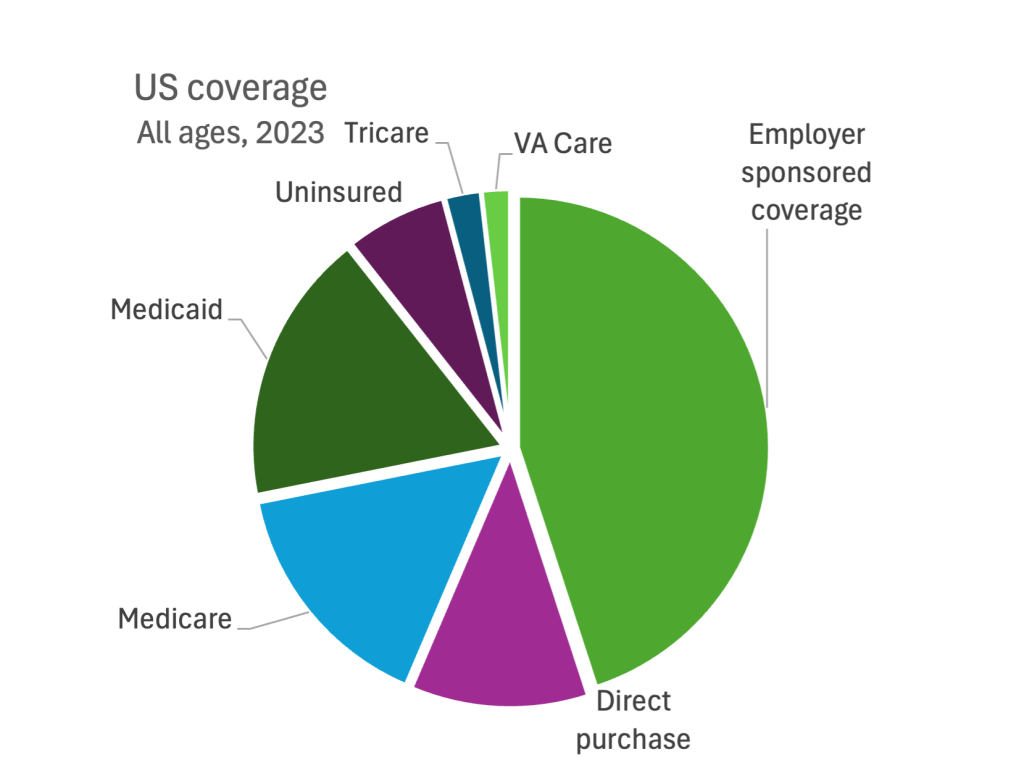
Health Insurance Coverage in the United States: 2023, US Census, September 10, 2024, https://www.census.gov/library/publications/2024/demo/p60-284.html
A 2022 survey found that one in four working age Americans have inadequate insurance that doesn’t make care affordable. Half of American adults would be unable to pay an unexpected $1,000 medical bill within 30 days.
One in eight state residents buy private insurance directly – either through AccessHealthCT, Connecticut’s health insurance exchange or independently through a broker or insurer. That number has grown since passage of the Affordable Care Act, as AccessHealth CT offers federal subsidies on coverage for people with incomes that qualify.
Three in ten Connecticut residents are covered by HUSKY, Connecticut’s Medicaid program. There has been significant growth in Medicaid enrollment for decades, because of recessions, Connecticut’s Affordable Care Act expansion, and the COVID pandemic.
Almost one in five state residents are covered by the federal Medicare program. That number is slowly growing, mainly because of the rising number of aged Americans.
Uninsured
As in the past, Connecticut residents were less likely to go without health coverage than most Americans in 2023. Both US and Connecticut uninsured rates rose steeply with the 2008/2009 recession and dropped in 2014 with implementation of the Affordable Care Act. Despite high unemployment, the COVID recession did not raise the uninsured rate thanks to federal protections.
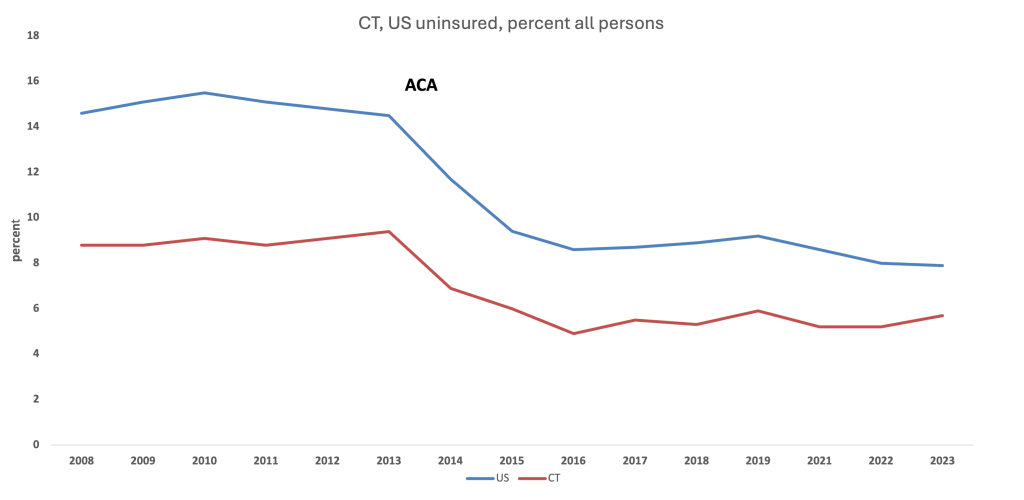
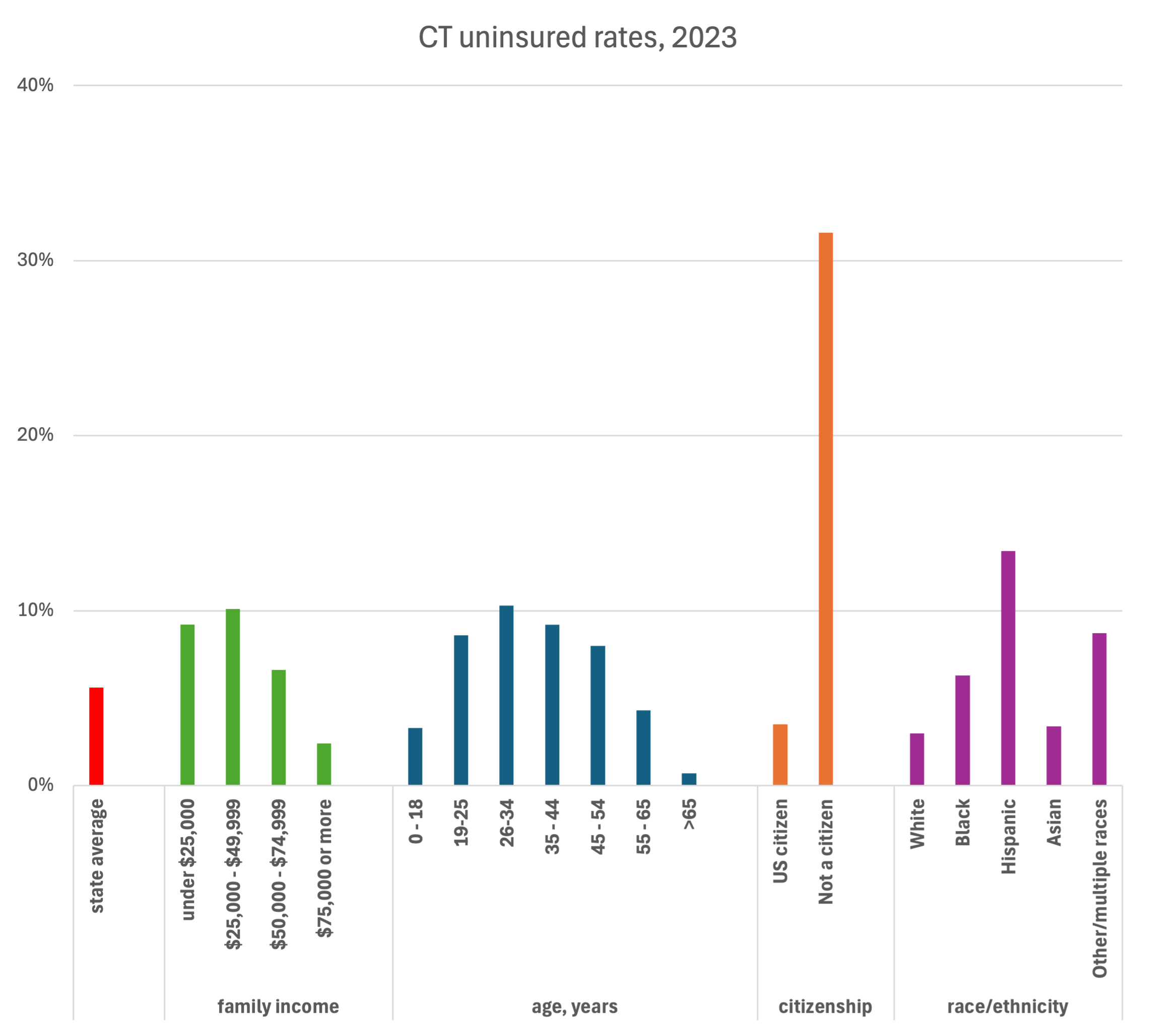
While Connecticut’s uninsured rate at 5.7% is lower than the US rate at 7.9%, it represented 205,000 state residents in 2023. That’s greater than the population of any Connecticut city or town. Connecticut’s uninsured are more likely to have low family incomes, be middle-aged, Hispanic, and not a US citizen.
Impact of uninsurance on people and the system
Uninsured adults are three times less likely than other Americans to have had a medical visit in the last year and are less likely to get regular, preventive health screenings. Uninsured American children are ten times less likely to get needed care than other children. Because they miss preventive care and screenings, the uninsured are more likely to be diagnosed at later stages of disease when problems are harder and more costly to treat. One in four has postponed needed care due to cost in the last year, compared with 6% of privately insured Americans and 8% with Medicaid coverage. One in five didn’t get needed care and 14% postponed or didn’t get a needed prescription drug in the last year due to cost.
When they access healthcare, uninsured patients get less care than other patients. A study of severe auto accident victims in Wisconsin found that patients without health insurance or Medicaid had 20% shorter hospital stays, received fewer services in the hospital, and were 37% more likely to die of their injuries. The researchers controlled for crash severity, vehicle type, injury, and personal characteristics.
There is a persistent myth that healthcare is free for uninsured Connecticut residents through emergency rooms, community health centers, and hospital clinics. This is untrue. Uninsured patients are charged for their care. Sometimes fees are discounted by income, but very often uninsured patients are charged higher rates, as much as 50% higher, than insurers or government plans pay. Two thirds of bankruptcy filers cite medical problems as a cause. In a 2019 survey, 74% of uninsured American adults cite the high cost of coverage as the reason they are uninsured.
Health insurance in Connecticut is expensive. Connecticut has among the highest insurance costs in the nation and it’s increasingly unaffordable for people and for employers. Connecticut workers are less likely to be offered employer coverage at work than the average American worker, and if they have an offer, they pay significantly more in premiums and deductibles. A benchmark plan on Access Health CT this year is $7,932 without subsidies, the sixth highest cost among states.
Uninsurance is also a burden on providers, communities, and taxpayers. As uninsured and underinsured patients tend to have lower incomes, very often they cannot pay for the care they need. Care for people who couldn’t pay their bills cost Connecticut hospitals $250 million in 2023. Independent practices may also incur uncompensated care, but the amount is unknown. Providers who don’t get paid will have to raise prices for the rest of us – and we can’t afford that. Studies link rising healthcare prices to higher unemployment, lower wages for people who still have jobs, and reduced tax revenue.
Impact of the Affordable Care Act
The 2014 Affordable Care Act (ACA) coverage expansion reduced Connecticut’s uninsured rate significantly and changed sources of coverage in our state. Connecticut chose both the ACA options to expand Medicaid to low-income childless adults and to operate a state-based health insurance exchange, Access Health CT. Both these decisions lowered our uninsured rate. But thankfully, expected reductions in employer-sponsored coverage haven’t happened. Medicare continued it’s slow increase and employer-sponsored coverage continued its slow decline, both of which pre-dated the ACA.

Both US and Connecticut employer-based coverage rates have been slowly declining, beginning with the 2008 recession. Implementation of the Affordable Care Act in 2014 had little or no effect on the rate of employer-based coverage.
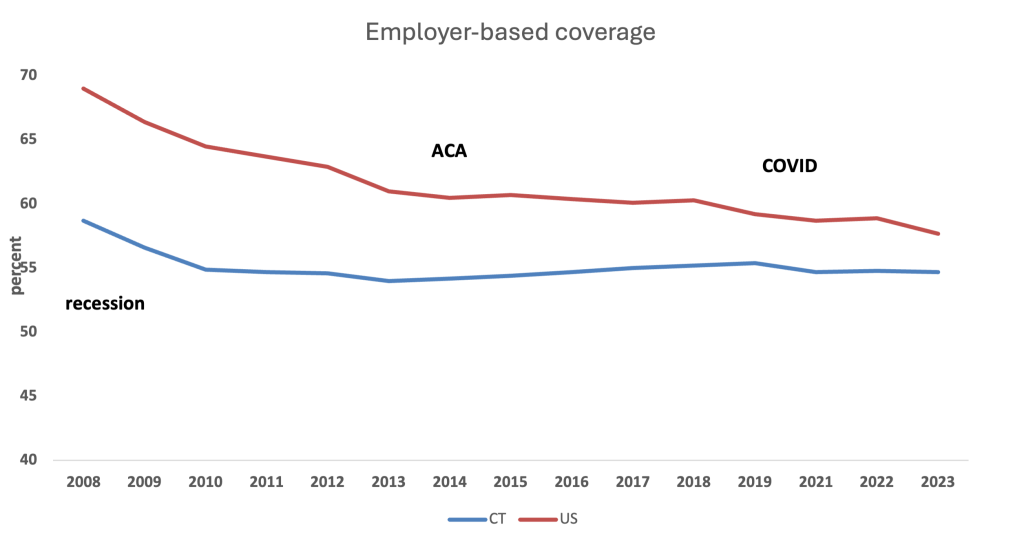
Economic forces can have a much larger impact on coverage than changes in healthcare policy. While the ACA had a large impact on Connecticut healthcare coverage, the impact of the preceding 2008 recession was even larger. As large numbers of Connecticut residents lost their jobs, they also lost their employer-sponsored coverage. Many bought individual insurance directly and others qualified for Medicaid because their incomes dropped. Some became uninsured.

The percent of uninsured Connecticut residents dropped from 9.1% in 2012 to 5.9% by 2016 due to Connecticut’s decisions to expand Medicaid under the ACA and to develop a state-based health insurance exchange, Access Health CT.
There were concerns when the ACA passed that expanded public options for coverage, including Medicaid and federally subsidized health insurance for lower income households, that employers would stop offering coverage to employees. However, employer-sponsored coverage for Connecticut residents had been declining before the ACA expansions were implemented. The ACA had little impact on employer-sponsored coverage for Connecticut residents but did increase Medicaid enrollment while uninsurance declined.

Connecticut Medicaid enrollment grew substantially when the state expanded Medicaid under the Affordable Care Act, and again during the COVID pandemic. During the pandemic many people qualified when they lost their jobs and their incomes dropped. In addition, the federal government increased funding to the state with the condition that states not remove anyone from the program during the pandemic. That protection ended in 2023.
Health insurance coverage is not full protection from healthcare costs
While 5.7% of Connecticut residents are without any healthcare coverage, more are at serious financial risk, despite having health insurance coverage. Connecticut’s Healthcare Affordability Index estimates that 13% of Connecticut residents could not afford healthcare costs in 2022. The researchers found that 15% of state residents with employer-sponsored coverage and 20% of people with individual coverage through our state’s health insurance exchange could not afford healthcare costs. (As Medicaid currently has no cost to members, it is affordable.)
According to a survey by the Commonwealth Fund, 23% of American adults are underinsured. This means their out-of-pocket costs (on top of monthly premiums) is over 10% of their household income, (5% for low-income households) or their deductible is more than 5% of household income. Two in five underinsured Americans did not get needed care for a health condition and 32% did not fill a prescription. Almost half (44%) have medical debt they are paying off.
Underinsurance is growing as healthcare plans become less generous. The majority of people with hospital debt now have health insurance, but it didn’t cover their costs. In 2018, just 11.1% of hospital debt was from patients with insurance; by 2022 that number was up to 57.6%. A recent study found that medical debt not only affected patients’ finances but also their physical health. Researchers found that across US counties, a one percent increase in people with medical debt during the past month was associated with 18.3 more physically unhealthy days and 17.9 more mentally unhealthy days per 1,000 people. It also correlated with 1.12 years of life lost per 1,000 people, and higher mortality rates. A growing number of Americans are turning to crowdfunding sites to cover medical costs. A study found that GoFundMe appeals for medical debt relief grew 25-fold from 2011 to 2020.
Undocumented immigrants
The uninsured rate among Connecticut non-citizens is nine-fold higher than for citizens. Immigrants without legal status in the United States are barred from enrolling in AccessHealthCT coverage and Medicare. Because the state cannot get federal matching funds for undocumented immigrants in Medicaid, Connecticut like most states, did not cover immigrants without legal status in the past. But in 2021, the state changed the law to cover children to age 8 that are income eligible, regardless of immigration status under Medicaid starting in 2023. In subsequent years, the law was expanded. Now all children in Connecticut up to age 15, within income limits, can be covered under HUSKY. Their coverage will continue until age 19. The state pays the full costs of coverage for these children; no federal dollars contribute to their coverage.
However, as of June 2025, the federal government is considering penalizing states that cover undocumented people, including children, in Medicaid, even if the state uses no federal funding for that coverage. As of April 2025, that included over 15,000 children.
In June 2025, the federal Medicaid agency began sharing data on immigrant members, including legally eligible residents, with federal deportation officials to make it easier to find people to deport. This adds to immigrants’ fears about accessing needed medical care or applying for coverage, even if they are eligible.
Trends
- The future of coverage in Connecticut is very uncertain as of this writing in June 2025. Current versions of federal proposals could result in about 140,000 more uninsured in our state. This would raise Connecticut’s uninsured rate to a 20-year high. The proposals would also shift billions of dollars onto the state budget, potentially increasing taxes and/or reducing other state services.
- It is expected that Medicare will grow as Connecticut’s population ages.
- Employer-sponsored coverage will continue to decline as premiums, and the underlying prices of healthcare services, continue to increase making coverage unaffordable for more employers
- Enrollment in AccessHealthCT will fall as federal COVID insurance subsidies to make coverage affordable end in December 2025. But there may be some growth at higher income levels as employer-sponsored coverage continues to decline.
Updated June 16, 2025